-
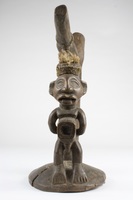
A figurative sculpture depicting a hanged man with arms tied behind his back. Facial features are exaggerated and stylized, with a fiber headdress on top of his head. This sculpture is seen as a cult figure that could be used to warn criminals who might face the fearful penalty for their unethical actions.
-
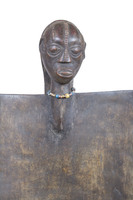
The Tawba ceremonial chair is highly decorated with triangular patterning surround the base of the chair and back side. The bust at the top of the seat has thinly carved scarification patterns and a stylized coiffure. The neck of the bust blends seamlessly into the seat, connecting the two objects as one. The seat has several marks and scratches, showing the chair was most likely functional as well as decorative.
-
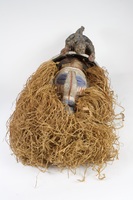
The Yaka "kholuka" mask is carved of wood with raffia surrounding the head. The nose is turned upward, the mouth is open with individually articulated teeth, and the face is brightly painted creating an expressive image. This facial construction is used to depict Yaka sexualtiy and spirituality. Atop the head is lizard constructed of tightly joined fabric pieces, covered in pigment of similar coloration to the face. The mask is representative of those used during initiation rituals like the "n-khanda" ceremony marking the transition from boy to man.
-
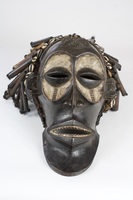
The Chokwe Pwo, or Mwana Pwo mask is made of wood with both white kaolin and a oils to patinate the surface. The eyes are narrow in large sockets, with scarification patterns running downward over the cheeks to signify tears. This mask resembles a maternal figure in a highly emotional male initiation ceremony. The mouth is wide, with teeth lining the top and bottom lip. Under the mouth, the chin juts outwards with a rounded edge. Atop the head, a hairstyle of beads drapes downward, connected to the forehead by a thin line of cowrie shells.
-
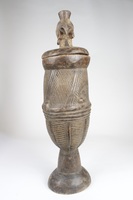
The large vessel is carved of wood with a dark patina, along with red pigment and white kaolin on the surface. Thinly incised lines cover the surface of the vessel creating intricate patterns. The lid has two busts of a chicken on either side of a cylindrical handle. The chicken may be in reference to animal sacrifice, as the killing of the chicken during rituals was commonly understood to protect from illness and other troubles.
-
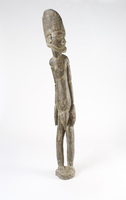
The male figure is carved from one piece of wood, as if stemming from the rounded base beneath its feet. The figure is thin with a vertical emphasis. Common characteristics of Dogon sculpture can be seen through the bend in the knees and the turned head. Carved statues such as the one pictured were often ancestral figures placed on altars.
-
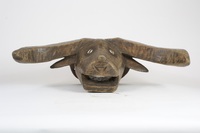
Kiyunde (buffalo) mask with elongated horns flaring out on both sides and a squared-off snout with shell eyes. It represents the male wild buffalo and is connected to ideas of strength, leadership, and cultural heroes.
-
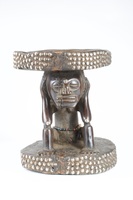
The Luba stool is carved of wood, with metal pins lining the base and seat. Thin sheets of metal can be seen on the base of the stool and on the seat in line with the front of the figure. These metal sheets may have been used to repair cracks in the wood. The figure is seated with its elbows resting on its knees, and hands cuffing around the ears. Female genitalia can be seen on the figure, along with colorful glass beads wrapping around the waist. They elbows and glabella have been decorated with metal pins. The face of the figure has a horizontal emphasis, with narrow eyes and a thin, wide mouth. This highly decorated Luba stool was most likely used by those in leadership roles. Stools of such a style were often used as decoration, however this stool appears to have some wear as noted by the metal sheets.
-
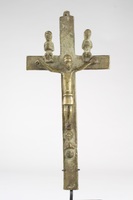
The bronze crucifix was used as a symbol of chiefdom in the Kongo society, also seen as a symbol of spiritual power. The cross shape and representation of Christ was informed by earlier European versions.The crucifix has four figures; Christ in the center and three praying figures surrounding him. The placement of the figures is quite common in the Kongo depictions of the crucifix. The depiction of Christ in this crucifix reflects the imagery and aesthetics of the Kongo style, as seen by the modeling of the body and coiffure.
-
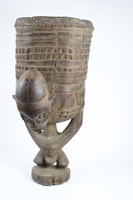
A figure with a stylized body holds up a cylindrical drum, marked with bands of geometric patterns all over its surface. It could be used during ritual ceremonies, mainly at burials and memorial celebrations. It always belongs to the community, not an individual.
-
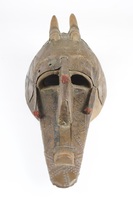
The copper plated mask has a vertical emphasis, forming a narrow face. Two small wooden horns are attached to the front of the forehead, and three thin rods hang below the brow bone with small tassels. The facial features and overall formation of the mask is reminiscent of the Bambara and Marka "Ngolo" or "N'tomo" masks, which have a ceremonial function, providing strength and protection.
-
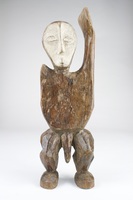
Wooden standing male figure with white kaolin, heart-shaped face. The figure has one arm extended upward and the other appears to have been excluded from the design intentionally.The central abdomen is flat, carved into a board like shape. When used in ceremonies, the figure may have small holes carved into the abdomen. This object would have been within one of two baskets among other wooden figures for initiation ceremonies.
-
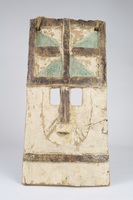
The Kumu face mask is composed of strong geometric forms and contrasting patinas. The surface is primarily coated in white kaolin, with dark wooden lines creating a grid-like formation. Light blue forms reflect one another to create symmetrical balance above the minimalistic facial features. Thinly carved scarification patterns can be seen on either side of the face, descending from the corners of the nose. This pattern can be seen on many Kumu masks from the time period.
-
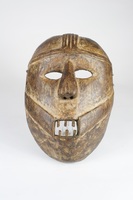
The mask is carved of wood with incised lines marking facial scarification patterns typical to the Azande style. The eyes are small, hollow ovular forms, and the mouth is rectangular with small wooden teeth inlaid along the edges. A band of three lines wraps around the forehead, a second band runs vertically towards the back of the head.
-
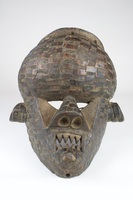
The Salampasu Mukinka mask has various recognizable features such as the bulging forehead, sunken eyes and sharp teeth. The mask is covered in copper plates, forming a hard surface. The mask was to be worn during ceremonies honoring brave warriors.
-
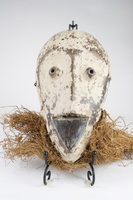
The Lega mask has a vertical emphasis formed by the narrow face and long, thin nose. The mask is painted with kaolin pigment, providing a stark white patina. The raffa is attached through small holes along the chin, extending below the wooden mask. An upper lip protrudes from the plane of the face, and small rounded eyes with cavities rest in large orbitals defined by a high ridge of a brow bone. This Lega "Bwami" mask would have been utilized in initiation ceremonies open to both men and women. The Bwami is important to Lega identity, supporting social and political life.
-
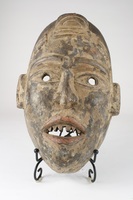
The carved wooden mask may resemble the '"seer" or "Ngobudi" type mask like that of the neighbouring Yombe people. These mask are unique in their design, as the features appear quite naturalistic. The hollowed eyes and slightly opened mouth create an expression of clarity, possibly in reference to the ritualistic function of the mask. The surface is rough, with remnants of dark pigment, and red on the lips and forehead. A band of three lines wraps the forehead dividing the face and the coiffure. In the center, a semicircular form extends from the forehead. This detail is a common motif in both Ngobudi and Nganga masks.
-
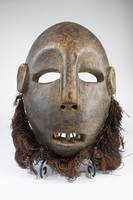
The carved mask has a rough surface with remnants of natural materials pressed into the wood. Along the chin, raffia has been woven through hollowed grommets. The facial features are minimalistic, with little detail in the eyes and nose. Lining the upper lip are small teeth, potentially from a small animal. Round ears rest on either side of the mask, creating a symmetrical face.
-
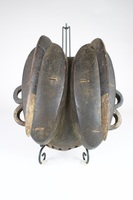
The ovular wooden Ligbi mask has two faces, with thin slits for eyes and thinly painted lines for the mouths. Hanging vertically from the top of the mask, covering either face, are forms that resembles the beak of a hornbill bird. On either side of the mask are sets of double ears created by semi-circle loops.
-
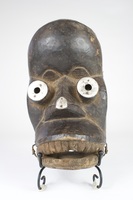
Carved wooden mask, with hinging jaw and round iron forms to represent eyes. The forehead and the upper jaw protrude, to create exaggerated features. The Dan mask may be associated with forest spirits, manifesting their powers. This mask can be grouped into the 11 major types of figures used to represent varying social topics such as education, politics and entertainment.
-
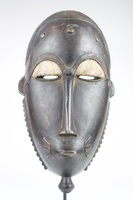
The Baule mask is carved of wood with a dark patina and kaolin on the rounded eyelids. The face is smooth and narrow, with a large forehead. The nose is elongated, met by a small mouth close to the bottom of the chin. A small false beard is centered on the end of the chin. Atop the head is a stylized coiffure marked by delicately incised lines. Three round protrusions line the forehead, thin patterns fill the eyebrows, and lines extend outward from the corners of the mouth; all potentially representing scarification patterns. Wrapping around the face are small triangular forms, a common characteristic of Baule face masks.
-
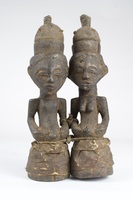
The male and female twin figures are joined by thin rope that has been tied at both the waist and crook in the arm. The figures have recognizable characteristics of Kusu art. The patterning around the top of the forehead and chin are common, along with the closed eyes, rounded lower abdomen, and style of the arms. The figures may have been created prior to the birth of twins as a form of good luck, or created after their death in order to appease the spirits of the deceased.
-
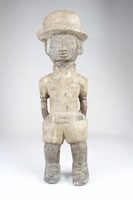
The small, standing colonial figure represents the influence of the European settlers in the Baule area in the early 20th century. The figure is painted to reflect the aesthetics of European attire, such as the large white hat. It was common practice for small standing figures to be made as "spirit lovers", or an ideal vision of a spouse. It is possible that the small colonial figure was created as a spirit lover, that reflected the new societal ideals introduced by the Europeans.
-
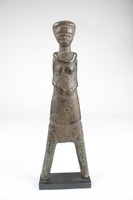
Small, thin female standing figure with minimalist details. Breasts, necklace, and incised lines around the waist and thighs to resemble clothing. The arms are kept close to the body, with the hands resting above the small, circular navel. The legs are stout and thin, spread wider than the shoulders, creating a pyramidal composition with the head at the top. The eyes are large for the face and the mouth is slightly open. A stylized coiffure has been carved on the head, expanding upwards but cut horizontally at the top. This figure may be a representation of the Blolo Bla, a spouse from the spirit world.
-
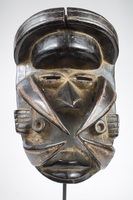
The Gere mask is carved of wood with a thick, dark patina. The forehead bulges forward, with a thin central division. The eyes are formed by narrow horizontal openings under the forehead. The nose and mouth extend forward with sharp angles to compliment the four horns that round inward to the center of the mask. on either side of the face, under the nose, are small holes alongside horizontally incised lines.