-
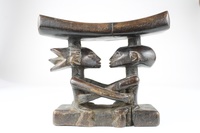
The Luba wooden headrest is decorated with two seated figures in an embrace with stylistic coiffures. The headrest was used by high-ranking dignitaries for comfort when sleeping and for the protection of elaborate hairstyles.
-
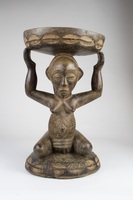
The carved wooden stool has clear characteristics of the Luba style, such as the facial features and seated position. The figure is female with a round abdomen and pronounced navel, decorated with scarification patterns. The base of the stool and round seat supported by the figures arms are decorated with a wrapping pattern depicting cowrie shells. The stool has a functional construction however it was most likely used for decorative reasons, or as a metaphorical seat of kingship for the Luba leadership.
-
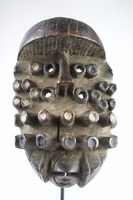
The large wooden Bete mask is coated in a dark, glossy patina with white kaolin and a blue pigment in the centers of the cylindrical protrusions across the face. Four of the central circles have been hollowed out, for the masker to see and breathe out of. A large overhanging, rounded forehead juts over the eyes and nose. The mouth is tucked underneath the lowermost row of cylindrical forms, and is defined by a thick incision to separate the top and bottom lip. The Bete Gle or Gre mask was used in ceremonies to represent the hostile forest spirits, establishing the maskers as protectors of the spiritual forces.
-
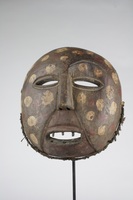
The carved wooden mask is detailed with a polychromatic pattern of dots, potentially representing the bodily decorations applied during ritual practices. The overall form is round and the mask has a low relief with minimalistic facial features. Teeth, formed by small pieces of wood, line the wide mouth. The eyes are narrow and hollow with thin incised lines above them marking the brow.
-
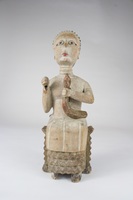
A seated wooden female figure, grasping a snake in one hand, and an open space within the clenched fist of the other. The figure has naturalistic, yet exaggerated features and a stylized coiffure. The figure may represent royalty, potentially depicting a Queen Mother, as it is seated in a highly detailed chair and covered in a chalk-like pigment. On festival days, Akan royalty would cover their skin in white powders to show their reverence and devotion.
-
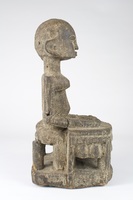
Two seated figures playing the balafon, an instrument that was relatively uncommon in Dogon communities. The Balafon was used for ceremonial purposes. The sculpture itself could be in reference to two specific characters from the epic narratives of the formation of the Mali empire, Sologon and Bala, ca. 1230. Twin figures are seated in front of a xylophone-type instrument, with mallets in each hand.
-
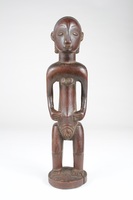
Standing, wooden female figure with clear characteristics of the Luba style, such as the highly polished wooden surface, broad and round forehead, and thinly inceside facial features. The figure may be a standing Mboko, or diviner. The Mboko were used during ceremonies regarding the induction of a new chief. Natural materials of medicinal value would be packed within the figure, as to the Luba, women were believed to have a strong connection to the spirit world.
-
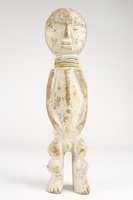
Small standing figure carved of wood, with remnants of white kaolin. The figure has been sculpted with a vertical emphasis, as the arms remain attached to the sides of narrow hips. Beads wrap tightly around the neck, dividing the large head from the body. Several iron nails line the forehead of the figure.
-
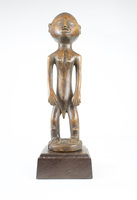
The small male standing figure is carved of wood with remnants of a dark patina on the surface. The figure has a large, round head with circular eyes and an ovular open mouth. The body is thin, with a gap between the arms and torso on either side. Pectorals and the navel are marked with small circular protrusions of low relief. Male genitalia can be seen under the low belly. The knees appear to be pronounced, as they extend forward from the legs.
-
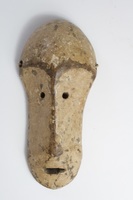
Small Lega mask with recognizable characteristics such as the heart shape of the brow bone and long, slender nose. The Lega mask was used by in initiation ceremonies, and was rarely worn on the face, but rather used as decoration on the body or held in one's hand.
-
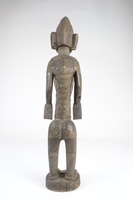
The carved wooden female figure has clear characteristics of the Bambara style, such as the coiffure, head shape and facial features. The face is concave, with small pinholes for eyes, and a long, narrow centered nose. The large ears have pierced holes, potentially adorned with jewelry during use. The shoulders and abdomen are decorated with scarification patterns that can be seen on other female figures from the Bambara culture.
-
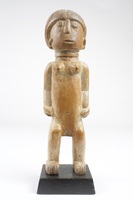
Standing female figure carved of wood with few details painted in black. The hairstyle is defined by incised lines on the top of the head that angle downwards toward the back of the neck. The face is flat, with features of a low relief, and small ears on either side of the head. The body is long with stocky legs, with no sharp edges but rather very rounded forms.
-
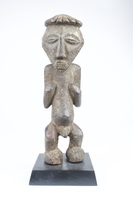
The small male ancestor figure has clear characteristic of the Hemba style, such as the long face and torso, and stylized patterning around the chin. The coiffure atop the head has radiating incised lines stemming from the center to mimic strand of hair. The eyes are closed, yet the mouth is open, forming a rectangular shape with small teeth. Arms rest high on the chest, and the legs are thick and stocky.
-
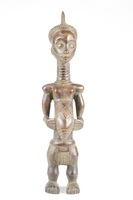
The carved wooden female ancestor or power figure is highly decorated with scarification patterns and incised lines marking the collar necklace and loin cloth. The figure may be a representation of the "Mupaki wa manga" power figure, protecting from and controlling otherworldly forces.
-
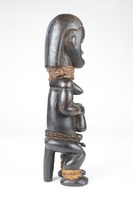
A seated wooden figure holding a small vessel with arms and legs wrapped in rope.The Byeri, or reliquary guardian figure, has supernatural properties that ward off evil spirits and bring good fortune. The figure has a calm expression yet is carved to depict strength through the detail of musculature.
-
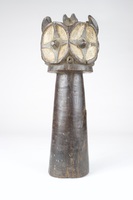
The Bembe Janus head symbolizes the Alunga mask. The Janus head has noticeable characteristics such as the double faced composition with large conical eyes. The eyes protrude from cross shapes of black, contrasting the white kaolin circles beneath them. Alunga is described as a spirit or force that can affect the living, specifically connected to hunting and the forest.
-
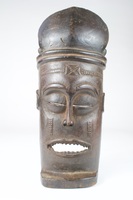
The wooden Pwo mask represents a female archetype, an ancestral personage who encourages fertility. The vertical lines descending from the narrow eyes resemble tears, while the symbol in the center of the forehead is believed to be a cosmogram. The Pwo masks were often highly decorated, with raffia and other natural materials.
-
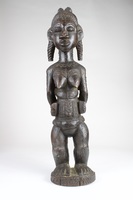
Wooden standing female figure with child on their backside. The figure has a unique, detailed coiffure and scarification patterns on her face, chest and torso. Images of women with children depict a woman's completion of adult responsibilities.
-
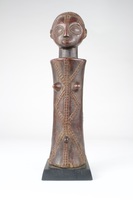
Wooden Mpundu female figure consisting of an elongated, round torso and head. The head has the detailing of a stylistic coiffure, marked by incised lines in the wood. The torso is decorated with scarification patterns along the vertical axis surrounding the breasts and navel.
-
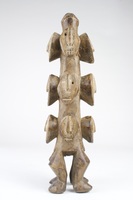
The religious figure is known as the Sakimatwematwe, meaning "the man with many heads". In the Lega community, the figure represents qualities such as wisdom and discernment, allowing the owner to see all sides of an issue in order to have success in their choices. The figure has several heads, placed on the vertical axis, creating a four-sided figure. The wood is coated in white kaolin, and each face shares similarities, however they are not all uniform.
-
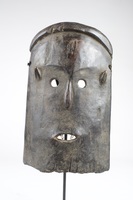
The Fipa mask is carved of wood in rectangular form with a low relief. The mask is coated in a glossy patina, yet the material nature of the wood is present through cracks and rough texture. Facial features are simplified, yet expressive. The eyes are circular holes that rest underneath the rounded brow bone, and divided by the ovular nose. On the outside edges of the mask are thin protrusions resembling ears. The mouth is centered in the lower section of the mask. It is comprised of a hollowed almond shape with inlaid animal teeth. At the top of the mask, a carved band wraps around the forehead with two jagged cuts, potentially eluding to the coiffure.
-
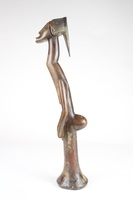
The elongated figure features a slender, curved neck leading to a rounded head adorned with an intricately carved headdress, protruding buttocks, and pointed shoulders with a rod-like lower half, possibly for support. This figure could represent an ancestor or symbolize authority.
-
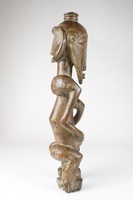
Standing female figure, carved of wood with identifiable characteristics of the Hemba style such as the head shape, coiffure, ovular eyes and beard like detail around the face. One hand rests on the pronounced navel, with the other angles upwards towards the chest. The female genitalia has been exaggerated, possibly expressing a maternal function or image of fertility.
-
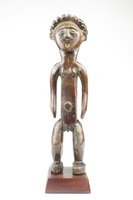
The standing male figure is carved of wood with a dark patina. The head is proportionately larger than the body and topped with a stylized coiffure. Ears have been carved on either side of the head in line with bulging eyes and a centered nose. The mouth is square in juxtaposition with the rounded forms of the other features. Above the eyes on the brow ridge are small holes indicating scarification patterns. Arms reach downward towards thicker, short legs. The abdomen is long and narrow, with carved breasts and male genitalia, along with a protruding navel.
-
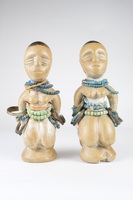
The wooden carved female twin figures are highly decorated with dark pigments, glass beads and metal jewelry. The bodies are rounded, kneeling with their arms at their sides. The eyes are closed with thinly incised lines marking the eyelids. Scarification patterns run vertically up and down the cheeks. Twin figures were created to commemorate either one child or the set of twins after death. Twins are believed to have spiritual powers in communities of Nigeria like Yoruba, thus memorial figures were often created.