-
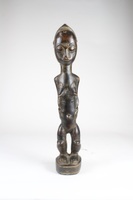
The carved female figure is thickly patinated, the dark coloring being a common characteristic of Baule sculptures. The figure has an elongated torso, with arms resting on the abdomen around a pronounced navel. Scarification patterns are present on the face and chest. The face presents a relaxed expression, with an undulating brow line above the large eyes. The figure is most likely of a fertility context due to the posture and expression.
-
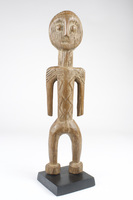
Standing figure with a large head and bulging, round eyes. Incised lines mark the patterning of the coiffure atop the head, along with scarification patterns on the shoulders, chest and abdomen. The neck and head have vertical lines carved into the wood, differing from the smooth wood of the arms and legs.
-
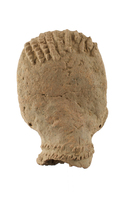
A terracotta fragment of a face with carved details revealing facial features, a necklace, stylized hair, and small holes for earrings. The neck broadens to create the shape of the large flat face. The eyes are circular, parted by a thin narrow nose of a higher relief, followed by a small ovular mouth.
-
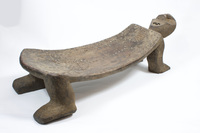
The wooden bed depicts an elongated human figure, standing on all fours with its chest facing upwards. Metal pins across the face and abdomen detail both facial features and scarification patterns. Animal teeth have been inlaid into the mouth. The bed was most likely used for decorative purposes, not for much physical use as there is a lack of scratching or markings made on the surface.
-
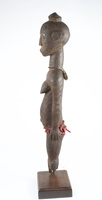
The standing female figure is carved of wood with a thick patina. Across the neck is a necklace of string with a metal ring and the waist is wrapped in red fabric. Thinly in side lines form scarification patterns across the abdomen, met by a pronounced navel. This scarification pattern can be seen on several Kulango figures. The face of the figure has a calm expression with narrow eyes and a closed, resting mouth. At the top of the head, a stylized coiffure protrudes upwards into a rounded cap.
-
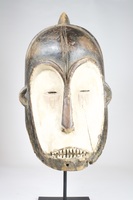
The large helmet mask is a type of Fang Ngil mask, recognizable by the usage of white kaolin to paint the face. The mask has two mirrored sides, both depicting a long heart shaped face. A thin, elongated nose divides the face in half connecting to the rounded brow bones above the eyes. The mouth is wide with rows of teeth protruding. Detailed lines have been carved into the top of the head in the patinated wood to resemble scarification patterns. The ngil masks were most likely worn by a male society during the initiation or reprimanding of members. The white kaoli may be in reference to the power of the ancestors.
-
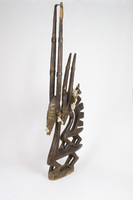
The large headdress resembles the form of an antelope, pangolin, and aardvark referring to the mythic Ci-Wara figure. In the Bambara culture, Ci-Wara was believed to have introduced humans to various aspects of nature and agricultural practices. During ceremonies celebrating the skills of successful farmers, two headdresses, one male and one female, are worn. Both male and female headdresses together signify the importance of unity for maintaining a strong community. The male Ci-Wara headdress has a large, narrow and long face decorated with metal plates and patterning. Cowrie shells have been added to the Fabric and small metal bells are attached towards the base of the tall horns, Rounded forms mimic the curve of the neck, radiating outwards. The body is low, with four short legs. The headdress emphasizes positive and negative space through its silhouette forms.
-
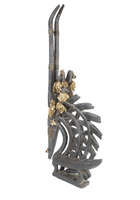
The headress resembles the form of an antelope, pangolin, and aardvark referring to the mythic Ci-Wara figure. Ci-Wara is believed to have introduced humans to the practice of agriculture. During ceremonies celebrating the skills of successful farmers, two headdresses, one male and one female, are worn. The inclusion of both male and female Ci-Wara headdresses symbolizes the unity between men and women as a key part in maintaining a strong community. This headress depicts the female figure with a smaller, child figure standing on its back. The headress is carved of wood, and has small metal bells that would have chimed during the performances. Cowrie shells and small pieces of fabric adorn the figures faces. Both faces are highly detailed and narrow. The bodies are more simplistic and rest on short legs. The mother and child figure create an interesting play of positive and negative space through their silhouette forms.
-
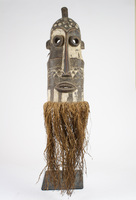
The large, vertical mask is known as the Phumbu a Mfumu mask, resembling the power and authority of a chief or executioner. The mask is used during times of social instability or crisis, when the chief must gain control over the community. The round, cylindrical eyes and bright patterns are designed to evoke a sense of aggression for the viewer.
-
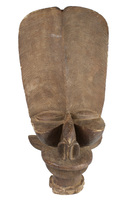
The large batcham mask is carved of wood with incised lines detailing patterns along the vertical panel on the crest. Eyes bulge forward on either side of a wide, long nose with flared nostrils. The mouth is large and rounded with thin vertical lines. Seen from the back of the mask is a hollow round cavity. The mask was to be displayed during funerary ceremonies or the appointment of a new chief.
-
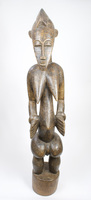
A large female figure with prominent genitals and hands near her belly reaching outward. This pose almost depicts her ability to bear children. Three linear scarifications are carved into her belly, roughly resembling the four cardinal directions. The same three-line scarifications are also engraved on her breasts and cheeks. This type of sculpture is used as a tool to secure ancestral blessings and was commissioned by Senufo diviners as intermediaries between the spirit world and the living.
-
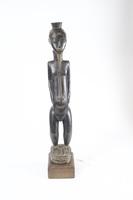
The small standing figure is known as the "Blolo Bian", the male spirit often accompanied by the female "Blolo Bla" The figure is highly decorated with scarification patterns on the abdomen and face, a long beard, and a stylized coiffure.The spirit figure was to be cared for by its owner, so the wood would be oiled regularly and dressed in cloth and jewelry.
-
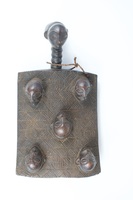
The Memory Board, or Lukasa, is carved of wood, with intricate patterns and several protruding heads. The long neck and head extending from the rectangular board has recognizable features of the Luba style, such as the rounded face and eyes, and stylized coiffure. The "kitena spirit" can be seen through the placement of the heads on the flat face of the board. The kitena signifies the burial place of a king or the elevated resting place of a spirit The heads commemorate the reign of kings, forming a memory landscape.
-
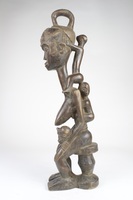
carved wooden sculpture of a seated female figure accompanied by three child figures. One child rests in the lap of the mother, while two cling to her back. The surface of the wood has been painted to deepen the color. The head of the seated female figure is proportionately large, depicting scarification patterns on her forehead and temples. A stylized, intricate coiffure atop the figures head creates a rounded arch. The small child figures are less detailed, with simplified facial features.
-
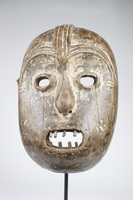
Round carved face mask with shallow facial features. Pronounced brow bones are detailed with scarification patterns, meeting in the middle of the forehead and continuing upwards to the top of the mask. The eyes are hollow ovular shapes divided by the rounded nose in between them. The mouth has four animal teeth inserted under the top lip. Scarification patterns are present on either side of the eyes and cheeks, marked by three lines stacked horizontally.
-
The bronze cast bell depicts a figure with its arms resting across the abdomen, and eyes closed. The head of the figure is enlarged, carved to meld with the overall shape of the bell. On either side of the figure is a relief of a feather angle upwards towards the handle fo the bell. The handle is thin, extending upwards within minimal decoration. In Yoruba practices, bells are often used to commemorate ancestors.
-
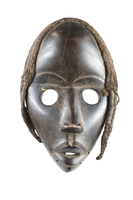
The wooden Dan mask has a large, bulbous forehead that moves downward to a narrow chin. The eyes are formed by large carved circles, which may identify this mask as a Gunye Ge mask used in foot racing competitions to be worn by the champion. Human hair has been braided and threaded through the small holes along the edge at the top of the mask. Similar small holes can be seen on the chin, potentially used to attach other facial hair or adornments.
-
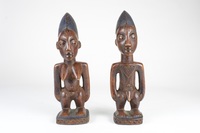
The male and female figures from the Yoruba community commemorate deceased twins. The coiffures signify their social status, turned blue by repeatedly dipping the top of the head in indigo. The indigo symbolizes the calming of the deceased's inner spirit. The small wooden figures are decorated in elaborate scarification patterns, sharing common patterns on the face and by the navel. The figures are bathed, dressed, and offered food as part of the ritualistic commemoration practices.
-
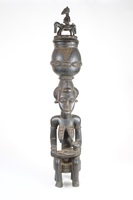
A sculpture depicts a seated maternity receptacle with a lid that features an equestrian figure. A seated female figure shows various scarifications on her breasts, where a baby is suckling to sustain his vitality. A line of a conch shell decorates the surface of a receptacle vessel. All these detailed elements are symbols of fertility. Although Senufo society is patriarchal, inheritance passes through the matrilineal line. The importance of maternity is generally reflected in the sculpture's content.
-

The carved tusk depicts an equestrian figure wearing a decorative cap with two faces, one on either side. The inclusion of the two faces may be a reference to dualism, or the dual nature of life. The features on the face have clear characteristics of the Dogon style, such as the large eyes and thin flat beard along the chin. Equestrian statues are common in the Dogon culture, as the horse acts as the agent that carries the human from life into death by raising them closer to the heavens.
-

The two headed figure has clear motifs of the Songye style, such as the bulging forehead, narrow eyes, jutting chin and angular posture. The janiform statue is a Nkishi power figure, used to for protection and healing. In the center of the chest, a female kifwebe mask can be seen painted with white and black kaolin. The presence of the kifwebe mask suggests that the power figure may also be used for funerary, initiation or fertility purposes as well.
-

The Lega religious figure is known as the Sakimatwematwe, meaning "the man with many heads". In the Lega community, the figure represents qualities such as wisdom and discernment, allowing the owner to see all sides of an issue in order to have success in their choices. The figure is round with roughly eight faces wrapping around the spherical shape. The stout form rests upon four thick legs with carved lines signifying toes. Atop the rounded center of the figure, a plume of feathers sticks out of small portion of natural material and wrapped twine.
-

The N'tomo mask pictures a young man with an elongated face and an antelope stemming from the forehead. Young men danced with the N'tomo mask during one of their initiation ceremonies, as a part of their transition into adulthood. The image of the antelope is mean to encourage skill in farming. Some other N'tomo masks depict female figures alongside the antelope to encourage a young man's success in courting as well. The mask is decorated with thinly incised lines signifying scarification patterns. The eyes of the antelope and other elements of the mask are enhanced by red beads. Cowrie shells line the prong-like shape behind the antelope.
-

The commemorative, seated mother and child figure is a common archetype of feminine beauty in Kongo history. The mother sits, cross-legged with a small child across her lap. The proportions are exaggerated, as the mother figures head is enlarged in comparison to the rest of the body. Though hollow, the eyes may have had inlaid glass. Eyes made of glass would indicate the commemorative role of the sculpture, as the reflective quality of the material serves as a connection to the ancestral realm. The teeth are filed and shaped along the top and bottom lips, and the nostrils flare outwards. The elaborate coiffure atop the mothers head indicates a woman of elite status. Spanning across the figures shoulders and chest are scarification patterns carved at a high relief. The child figure is less detailed, laying on its back with its arms placed over its torso.
-

Carved wooden bust of a head, still attached to the original cut of wood. The head emerges from the wood, leaning forward with wide eyes. The eyes are patinated a lighter pigment than the rest of the wood, with thin lines marking the pupils. The facial features are carved at a low relief, remaining close to the face. A horn-like shape protrudes from the top of the head along the simplified coiffure. The top of the head is concave, with a small crack and hole in the center.