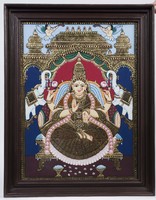
Thanjavur painting is a classical South Indian painting style, which was inaugurated from the town of Thanjavur (anglicized as Tanjore) and spread across the adjoining and geographically contiguous Tamil country. The art form draws its immediate resources and inspiration from way back about 1600 AD, a period when the Nayakas of Thanjavur under the suzerainty of
the Vijayanagara Rayas encouraged art-chiefly, classical dance and music as well as literature, both in Telugu and Tamil and painting of chiefly
Hindu religious subjects in temples. It is distinguished by its famous gold coating. However, it can safely be surmised that Thanjavur painting, as we know it now, originated in the Maratha court of Thanjavur (1676 -1855).(1) It has been recognized as a geographical indication by the government of India in 2007-08.
Thanjavur paintings are characterized by rich and vivid colors, simple iconic composition, glittering gold foils overlaid on delicate but extensive gesso work and inlay of glass beads and pieces or very rarely precious and
semi-precious gems. In Thanjavur paintings one can see the influence of Deccani, Vijayanagar, Maratha and even European or Company styles of painting. Essentially serving as devotional icons, the subjects of most paintings are Hindu gods, goddesses, and saints. Episodes from Hindu Puranas, Sthala-puranas and other religious texts were visualized,
sketched or traced and painted with the main figure or figures placed in the central section of the picture (mostly within an architecturally delineated space such as a mantapa or prabhavali) surrounded by several
subsidiary figures, themes and subjects. There are also many instances when Jain, Sikh, Muslim, other religious and even secular subjects were
depicted in Thanjavur paintings. Thanjavur paintings are panel paintings done on wooden planks, and hence
referred to as palagai padam (palagai = "wooden plank"; parlance. In modern times, these paintings have become souvenirs for festive occasions in South India - colorful pieces of art to decorate walls, and
collectors, items for art lovers, as also sadly sometimes, dime-a-dozen bric-a-bracs to be purchased from street corner practitioners.