-
 Sylvia
-
 Scrapbook
-
 Monument to President William McKinley
(Sketch for a Monument)
Monument to President William McKinley
(Sketch for a Monument)
-
 Newspaper Article_1920
 Very small newspaper article with no note on where it comes from. States "A portrait statuette of Maude Cuney Hare, the pianist, executed by the sculptress Meta Warrick Fuller, has been accepted by the Academy of Fine Arts, Philadelphia, and is now on exhibit at the Academy's 115th annual exhibition."
-
 Framingham? Newspaper Article_1924
 Short newspaper article, undated and unnamed. Title of the article is "Art Dept. Is to Conduct Meeting of Club Tuesday". There is a pencil arrow at the bottom right of this article that points to the letter (Eph1.41.153) below it. The article is as follows: "The meeting of the Women's Club next Tuesday will be in charge of the art department. Mrs. James Glass, chairman. The program will be given by Mrs. Rita Garrick Fuller, who will talk on "Student Days in Paris." Mrs. Fuller's work is well known in art circles and the afternoon is looked forward to with interest by club members. She will illustrate her talk with examples of her own work in sculpture and with pictures thrown on the screen of some distinctive types of sculpture and also of scenes and views in those parts of Paris more familiar to students than to tourists. Mrs. Fuller has spoken in other places on her subject, and is enthusiastic in her work and a thorough student of art in its highest sense. The afternoon promises to be one of the most profitable as well as enjoyable of the season. Tea will be served in charge of Mrs. Clarence Hall."
-
 Framingham? Newspaper Article_1924
 Short newspaper article, undated and unnamed. Title of article is "Framingham Women's Club" and is as follows: "Her student days in Paris will be outlined by Mrs. S. C. Fuller, the sculptor and a local resident, at the meeting on Tuesday in charge of the art department. Mrs. James Glass, chairman. The talk will be illustrated with some of her own pieces and with pictures of famous work, some by Rodin, whose pupil Mrs. Fuller was."
-
 Framingham News_1924
 Short newspaper article, undated and unnamed. The article states: "The meeting of the Framingham Woman's Club on Tuesday will be in charge of the art department, Mrs. James Class, chairman. The speaker will be Mrs. S. C. Fuller of Framingham, whose work in sculpture is favorably known in art circles. Mrs. Fuller, whose subjects will be "Student Days in Paris," will illustrate her talk with examples of her work and with pictures, including representations of some of the work of the French sculptor Rodin, whose pupil she was in Paris."
-
 Framingham Evening News_June 17 1919
 Newspaper article in three section. Headline is pasted along the top and states: "The Evening News, Framingham, Mass. Tuesday, June 17, 1919." Title for the article is "Models Panel/ for Y.M.C.A. Bldg./ At Atlanta, GA." Article is in two sections and is as follows: "Mrs. S. C. Fuller is completing, in her studio on Warren road, the modeling of a panel which is to be placed above a fire place in the new (colored) Y. M. C. A. building at Atlanta, Ga. The panel which is about five feet square is designed and executed with the spiritual conception and vivid life that characterizes all Mrs. Fuller's work. When finished it will be cast in plaster and after it is put in place will be bronzed. Interwoven in the design is the symbolic oak of Atlanta, and the motto of the association, "Spirit, mind, body." The central figure of the panel is a crouching Negro youth, about to rise. Over his shoulder appears a winged spirit, whispiring encouragement in his ear and urging him towards the light, the sun, to which it points. the face of the youth expressess slowly awakening aspiration, struggling with the dullness of long oppression. Chubby figures of little children surround the central figures, against with leaves and clusters of acorns, child figures represent the generations of the future, the hope of the race and are wonderfully individual, showing all shades of expression, "from grave to gay" and all sorts of poses. The words "Spirit, mind, body" are inconspicuously introduced, separately on small shield-like surfaces, in among the child figures. The thought is clearly worked out, the lines and modeling true and spirited and will convey, when finished and in place, the real inspiration that the artist intended. Mrs. Fuller always works with some difinite thought to be expressed and her descriptions are very illuminating to the unartistic observer. [end first section.] [start second section.] In her studio is noticable a life size plaster group which was exhibited in New York several years ago, illustrating emancipation. A slave youth and maiden, standing, under an over shadowing something representative of their servitude, have just been set free, from slavery. Behind them Humanity personified is urging them on, while Race-hatred holds them back. Bewildered they stand, looking to the future, but with nothing in their hands to help them, and with only the scantist clothing. Humanity, while urging them forward, weeps for their discouraging state. This group attracted a good deal of attention when exhibited. Mrs. Fuller, who was a pupil of Rodin in Paris, while a student, first attracted the notice of the great sculptor by the spiritual depth of conception and the intensity of life expressed in her work. A visit to her home and studio is an experience to be remembered with pleasure."
-
 Framingham Evening News _December 20, 1918
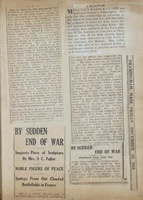
 Newspaper article in 4 parts from "Framingham, Mass. Friday, December 20, 1918" The title of the article is "By Sudden End of War/ Suggests Piece of Sculpture by Mrs. S. C. Fuller/ Noble Figure of Peace/ Springs From Out Clouded Battlefields in France". The article is as follows: Mrs. S. C. Fuller, Warren road, is at work upon a piece of sculpture, [start second section] the idea of which was suggested to her mind by the sudden ending of the war. The details are not all worked out yet, but the vivid representation of life that characterizes all of Mrs. Fuller's work is brought out in a manner that makes the observer share in the artist's inspiration. From the battle field strewn with dead and dying, with broken cannon and debris of the fight, rises a cloud, out of which springs a nobel figure of Peace. The right hand holds aloft a large banner, in the left is the olive branch. The face, strong and spiritual at the same time, shows the suffering, agony and suspense of the exultation of the final triumph, and a clear, long look into the future. Mrs. Fuller's thought was to show Peace, coming as it did, suddenly, out of a cloud, as it were, when we had expected to endure some years more of war. In the dim confusion of the battle field below, here and there a wounded man raises himself to look up and stretch a feeble hand towards the glorious figure, whose free lines, flowing drapery, its abounding life and the lofty conception of the whole, show in a striking manner the genious of the artist whose work [start third section] By Sudden End of War/Continued from Page One is too little known in Framingham. An earlier piece, done by Mrs. Fuller at the beginning of the war and on a similar theme, was on exhibition at the rooms of the Woman's Peace Party in Boston, some time ago, and was described in The News."
-
 Framingham Evening News_September 28, 1915
 Newspaper article in one column. The newspaper title is cut out and glued vertically next to the article stating "Framingham, Mass. Tuesday, September 28, 1915". The headline for the article is "Framingham Fair Notes/ Glimpses About Suffrage and "Anti" Booths/ Other Exhibits/ Flowers, Vegetables and Poultry By Children" Article is as follows: "Mrs. Solomon C. Fuller of Framingham whose work is sculpture is favorably known in art circles, has designed a medallion for the Framingham Equal Suffrage league, a plaster cast of which was on exhibition at the Suffrage booth at the Framingham fair. The design shows three heads in profile, in low relief, a man, a woman and, between and below them, a child. The thought accompanying is in letters at one side of the placque which is about eight inches in diameter, "Each unto each the rounded complement." The design of the three heads shows delicacy as well as strength of character, the ideal family, with perfect serenity and unity of interests in the home. It is a beautiful piece of work and was much admired by those who saw it. Some very artisitc posters from the state headquarters were exhibited on the wall at the back of the booth and a large map of the United States, showing the suffrage and the campaign states was suspended from the upper window. Sanitary drinking cups with a suffrage rhyme on them were a novelty and "Votes for Women" postal cards of various designs. The booth was presided over by Mrs. Manfred Bowditch, Miss Kingman, Mrs. M. E. Thayer, Mrs. and Miss Irving, Mrs. A. P. Sherman and others."
-
 Phil? Newspaper Article Headshot_1907
 Two clippings from a newspaper with a photo of Meta in profile and a small text beneath 'Miss Meta Vaux Warrick'. Clipped from the same article is 'Miss Meta Warrick, 'Philadelphia's busiest little woman' is having many nice things said about her by the press throughout the country. Miss Warrick is a young sculptor who has made an international reputation.'
-
 Virginian Pilot_November 10, 1907
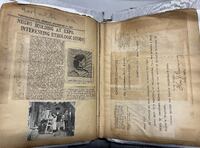
 Newspaper article in four pieces. The title of the newspaper is 'Virginian Pilot, Sunday, November 10, 1907' with a headline 'Negro Building at Expo. Interesting Ethologic Study'. The article has handwriting in pencil up the side ' Mrs. Edith Mr. Swith. a southern woman/This article was prepared by ...(rest is missing)' and in blue colored crayon on top 'Norfolk VA'. The article is as follows "...edge the wisdom of his teachings. As you enter from the east a series of historic tableaux, representing the negro in the different phases of our national life, at once attract attention. They were designed and executed by Meta Vaux Warrick of Philadelphia, who studied at the Art School in her native city and later on in Paris, and are most life-like. This young sculptor has other evidences of her talent in the building, and for these tableaux she has been awarded a gold medal by the Exposition Company. It may be said, en passant, that the exhibitors in the Negro building have thus far received 163 medals, twenty-six gold, fourty-four silver, and ninety-three bronze. Beginning with the landing of slaves at Jamestown in 1619, the scenes following represent successively: Work in the cotton fields; an escaping slave; organizing the first negro church, with colored minister and officers, in 1816; an old slave defending his master's home during the Civil War; first school house; beginning of home-making among the negroes (they own at present five million dollars' worth of property); negro soldiers, of whom there are four regiments in the regular army; negroes tilling their own farms (there are twenty thousand in this state who are farmers). The next two tableaux rerpesent the mechanic and a bank operated and owned by negroes (there are twenty-four of this kind in the United States); an improved home; a Sunday scene, and last a college commencement with Fred Douglas [sic] in the foreground."
-
 "Meta Warrick, Sculptress"
 Small newspaper article in two parts. Article is as follows: "The Freeman/A National Illustrated Colored Newspaper/ Meta Warrick, Sculptress. Miss Warrick is the sculptress of the group at the Jamestown Exposition depicting the progress and development of the Negro race since the first Negroes were landed at Jamestown in 1619. This group has been highly praised, though it was executed with such haste that it can hardly be fairly compared with her other works. She has had the distinguished honor of two examples of her work in the Paris Salon in one year. She delights in the horrible, the tragic and the grotesque. As a student her best piece was a head of Medusa and among her most famous pieces is 'The Thief on the Cross.' She has not yet attempted a bust of Senator Tillman or of the Rev. Thos. Dixon."
-
 The Afro American_July 20, 1907
 Small newspaper article in two sections. The article is as follows "The historic tableaux that have been executed by Miss Meta Vaux Warrick, of Philadelphia, have been entirely completed. The series, as heretofore annouced, represent the scenic reproduction of the history of the Negro from the landing at Jamestown until the present. These groups have been workd out with great artistic accuracy and the effect produced under the artifical lighting is simply grand. Dr. Thirkield, of Howard University, the other day said that this exhibit of Miss Warrick's was the finest thing in the Negro Building. In view of the very favorable comments on other features, this statement of Dr. Thirkield is exceedingly complimentary to the artist."
-
 McGirt's Magazine_1907
 Article on cream paper forMcGirt's Magazine The article is as follow: "Negro Artist Busy With Historic Task/Woman's Work Will Show Progress of Race Since the Landing at Jamestown./Government Contract/150 Figures, in 15 Groups, to Occupy Prominent Position at Exposition. After the introduction is a photograph of a drawing of Meta from the side facing left with pinned up hair under a large hat. Pinned to the last page is a newspaper article that goes into her works for the Tercentennial, similar to the article it is pinned to. Article is as follows: "Working from early morning until a late hour each night, a young negro artist, Meta Vaux Warrick, is endeavoring to complete 150 figures, representing the progress of her race from the time of the landing at Jamestown, Va., in 1619 to the present day. The figures are classified in 15 groups and are being made for the United States Government. They will occupy a prominent position in the Negro Building at Jamestown Exposition. The Artist's contract with the Government calls for the completion of the work by May 10. Property backgrounds, ten feet by ten feet, are now being painted in the artist's studio at 210 South Camac street, simultaneously with her work upon the figures, which are to be one-fourth life size. Classified groups and figures are: First. Landing at jamestown: Twenty slaves, five white men. Properties, scenery showing sea, ship, sky and landing; towers, houses and landscape. Figures, 25. Second. Negroes working in a cotton field. Properties, wagon, cotton, baskets. Figures, 10. Third. Slaves escaping, followed by two white men and a bloodhound - the negro hiding behind a clump of bushes and trees, water indicating he has crossed a stream and evaded pursuers on the opposite side. Properties, bushes and trees. Figures, 4. Fourth. Allen beginning the African Methodist Episcopal Church - Negroes worshiping in a blacksmith shop. Properties, anvil, books and furnace. Figures, 8. Fifth. Negro soldiers taking "The Order of the Day." Properties, guns and trees. Figures, 9. Sixth. Negroes protecting white women and children during the Civil War - A tramp soldier attempting to steal a white child; mother about to faint; a negress attendant at her side; a negro attacking the tramp to protect the child. Properties, chair, grass, flowers, trees and scenery. Figures, 5. Seventh. Negroes staring out after their emancipation - Man, homeless, surrounded by his family. Properties, bushes and trees. Figures, 6. Eighth. Negro schoolhouse - Children on their way to school. Properties, schoolhouse, books and trees. Figures, 15. Ninth. Negro farmer gathering his crops. Properties, house, crops and (start of second article) basket, Figures, 5. Tenth. Negro mechanic at work upon an unfinished building. Properties, lumber, house and tools. Figures, 4. Eleventh. Negro banker - interior of the bank, showing tellers or clerks and a depositor. Properties, books, money, desk and papers. Figures, 4. Twelfth. Negro church - Negroes about to enter the building. Properties, scenery, etc. Figures, 15. Thirteenth. Negro at home surrounded by his family; reading to his wife, who is doing embroidery and listening to the story; children playing and listening. Properties, rugs, tables, chairs and pictures on walls. Figures, 6. Fourteenth. Section A - Paul Laurence Dunbar writing verses. Properties, table, tablecloth, chair, pictures, couch and cushions. Figure, 1. Section B - Tanner painting from the model. Properties, easel, canvas, seats and drapery. Figures 2. Section C - Physician operating; nurses in attendance. Properties, stretcher, table, instruments and sheets. Figures, 4. Section D - Douglass delivering an oration. Properties, platform, table, pitcher, benches or chairs; scenery representing part of audence. Figures, 10. Fifteenth - Wilberforce community; students in caps and gowns, representing commencement day. Properties, trees, grass and scenery, including buildings, Figures, 18. Educated in Philadelphia This artist has been at work for several weeks on this task, and is liable to the infliction of penalties by the Government in the form of fines if the work is not completed by the contract date. She received her education in the public schools of Philadelphia and was awarded a scholarship to the School of Industrial Art of the Pennsylvania Museum, where she remained for five years, taking three prizes, among which were the first prize for metalwork design in 1898, and the first prize for modeling in 1899. She has exhibited in the Salon and has held two private exhibitions, one here and the other in Paris, where she studied under several noted men for three years. Her work is most instances has tended toward the gruesome, some of her notable figures being "The Man Eating His Heart Out," which personified loneliness; a second, "Oedipus Tearing His Eyes Out," and a third, "The Thief on the Cross," the latter showing the victim's horrible suffering. Interested in the Gruesome. Discussing this trend of her sculptural work, she said yesterday: 'Since the time I was a child here in Philadelphia, where I was born and have grown up, the gruesome phases of life have interested me. It was not that I searched for it, but simply that it came to mind. I had the habit of imagining the most horrible things and reciting them to my family as if they had actually happened to me. Many times I scared them badly. I suppose there are some who might say that I have a diseased mind.' She laughed heartily at this, and then told of a thought that occurred to her a few days ago with much relish as recalling her youthful fancies. 'It grew out of the murder case in New York and the use of the alienist term 'brain storm,'' she said. 'Remembering what awful pictures my mind conjured up at that time, I wondered and sought to answer my own inquiry whether the prisoner of the present trial ever was the victim of such imaginings as filled my childish head.' No member of her family, according to Miss Warrick, ever showed artistic talent, except a sister, who did not pursue her work beyond the initial stages. The young artist lives at 206 South Twelfth street.
-
 Philadelphia Record_April 13, 1907
 Long newspaper article with cut out newspaper title in two bars in the lower right stating "The Philadelphia Record, Monday April 13, 1907." The article is long, going into details about the Jamestown Tercentennial Exposition, with many objects and articles being shipped from Philadelphia to the exposition. It includes automobiles and trucks, baby shoe making, rugs, to name a few. Meta is mentioned at the end of the second column. "Negress Making Novel Exhibit. A most movel exhibit from this city will be a series of lay figures representing the progress of the negro race in America. There are 150 of these now in course of preparation, the sculptor being the young negress, Meta Vaux Warrick, of No. 206 South Twelfth street. The group has been contracted for by the United States Government for display in the Historical Building, and the work is to be completed and turned over to the Government by May 10. Failure to complete the last on time will involve heavy penalties on the young artist, and she is laboring many hours each day in her studio, at No. 210 South Camac street, to accomplish her task. The figures are divided into 15 groups, as follows: Twenty-five figures representing the landing at Jamestown in 1619; 10 figures, negroes, working in a cotton field; 4 figures, slaves escaping, pursued by owners; 8 figures, origin of African Methodist Episcopal Church; 9 figures, negro soldiers in camp; 5 figures protecting white women and children during the war; 5 figures, negroes, starting out in the world after emancipation; 15 figures, negro schoolhouse and children; 5 figures, negro farmer gathering his crops; 4 figures, negro bank and bankers; 15 figures, negro church; 6 figures, negro family at home; 1 figure, Paul Laurence Dunbar, negro poet, at work; 2 figures, Tanner, negro artist, painting from model; 4 figures, negro surgeon operating; 10 figures, Frederick Douglass negro orator, speaking; 18 figures, Wilberforce community, with students. Miss Warrick is a graduate of the Philadelphia schools, and spent five years in the School of Industrial Art on a scholarship which she won. There she took three prizes, and has since studied for three years in Paris under noted masters, exhibiting in the Salon and holding one private exhibition in that city and one in Philadelphia. Her work has attracted widespread attention and resulted in the award of the Government contract for the sculpture work for the exhibition. The figures are to be one-fourth life-size and the presentation will be aided by painted scenery now being prepared in the same studio.
-
 Philadelphia Herald?_1907
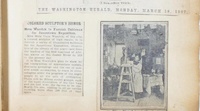
 Newspaper article in two sections with the title "Colored Sculptor's Honor" with a photograph of Meta in her studio. The article is as follows: "Meta Warrick to Furnish Tableaux for Jamestown Exposition. Miss Meta Vaux Warrick, of this city, a colored sculptor of high repute, is to furnish a series of illuminated tableaux for the Jamestown Exposition. Illustrative of the history of the negro race from the landing of the first boatload of African slaves on the Jamestown River in 1619 to the present day. It is Miss Warrick's plan to show by the construction of appropriate models, dramatic groupings and the use of suitable scenic accessories, to trace in chronological order the progress of teh negro people in all the arts of civilization. There will be fifteen model groups, each of the basic dimensions for ten feet long and ten feet wide, making in all an exhibit covering more than 1500 feet of floor space."
-
Philadelphia Press Newspaper Article_1906
Short newspaper article with handwritten notation above in black ink "Phila. Press/ Feb 1906". Article is as follows: "Advance in Sculpture./ The sculpture of the exhibition measures one of those great advances sometimes apparent in a single year." The article goes to list a number of artists. Meta is mentioned just below the middle of the article: "..., and has also some examples of delicious genre, one, "The Wind" (1015), Miss Meta Warrick has an auto-portrait in bronze (1017) of somber force..."
-
 Art Lecture on Paris Pamphlet
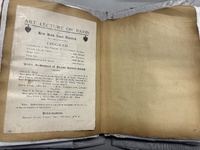
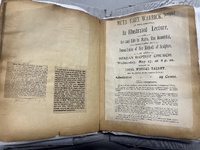
 Small pamphlet with the headline "Art Lecture on Paris/by/Miss Meta Vaux Warrick, of Philadelphia. Front lists the program of the following: "Introduction of Miss Warrick, U.S.J. Dunbar, Sculptor/Art and Life in Paris,...Miss Warrick/Tenor Solo,...Mr. Wormley./Piano Solo,...Miss Europe./Demonstration of Sculpture,...Miss Warrick." Below the program lists the officers and teachers of the Berean Church and Sunday School. Inside the pamphlet lists those who helped fund this lecture, listing two pages full of supporters. The back page lists a biography of Miss Warrick and a list of works which includes "The Wretched, The Thief on the Cross, John the Baptist, Peeping Tom, Sylvia, Secret Suffering, Death in the Wind, Silenus, Falstaff, The Man who Laughed' and several African sculpture types. Behind this is a very small newspaper article, which states "The Art Lecture of Miss Meta Vaux Warrick of Philadelphia, under the auspices of the Berean Sunday school on Wednesday night was highly enjoyed by a large and representative audience. The patrons numbered more than 150 of Washington's art lovers. Miss Warrick, after graduating from the School of Industrial Art in Philadelphia, studied three years in Paris."
-
 DC Newspaper Article_1905
 Small newspaper article with bold black lettering. Article is as follows: "A rare treat is in store for those who attend the lecture to be given by Miss Meta Vaux Warrick at Berean Church the 17th of May. The lecture will be illustrated and more than a dozen examples of her work will be shown and explianed to the audience. Miss Warrick will tell in her own inimitable way of life in the French Capital, where she spent three years, and had showed upon her encomiums from the greatest art critics in the world. Here is one from Gustave Coquit, a famous critic of Paris: 'You will be struck in this gallery with the attractive works of Mlle. Warrick, her grasp of grouping, and her characteristic capacity for interpreting life.' You should not miss Miss Warrick's lecture next month, for you are sure to be highly entertained and instructed."
-
 Evening Star_March 31, 1905
 Small newspaper article with a handwritten note below it in pencil stating "Washington 4-31-05". The article is as follows: "Miss Warrick Lectures on Art. Art Ideals and student Life in the French Captial was the subject of an interesting lecture yesterday evening by Miss Meta Vaux Warrick the sculptor, who recentlly returned from Paris and who is at present a member of the board of control of the Alumni Association of the Pennsylvania Museum of Art. The talk was before a number of prominent citizens who had been invited by Mesdames Hilyer, Pelham and Gray to meet the artist at a drawing-room reception. For an hour Miss Warrick entertained the company with an account of her Parisian experiences, and at the conclusion of her discourse gave a demonstration of her methods of work, a mass of clay, under he deft fingers rapidly assuming form and finally disclosing the characteristic lines and features of a kind-faced old man."
-
 International Studio_1905
 Magazine article with a photograph of 'Brittany Peasant' in the lower right. In pencil next to the article is written 'International Studio/April 1905'. The article is as follows: "At the School of Industrial Art, Broad and Pine Streets, Philadelphia, an exhibition of the work of Miss Meta Vaux Warrick was recently held under the auspices of the Alumni Association. Miss Warrick is of negro blood. After studying at the School of Industrial Art for five years, she went to Paris in 1899 where the next three years was spend in study under such masters as Collin, Carles, Injalbert and Rodin. From the latter she got much sympahty and encouragement, and her work shows his influence profoundly. As in Rodin's work, so in Miss Warrick's, strength of conception and vividness of imagination, combined with a passion for realism, are the paramount features. There was hardly a piece in the exhibition that did not depict some serious idea: some scene or phase of suffering; sometimes even a bald expression of something unpleasant, but very real. It leads one to theorize that her work is the (perhaps unconscious) expression of the trials and sorrows of a once oppressed race. The strength of feeling and the depth of insight behind the work, and the broad, almost coarse, touch of the artist that does not mince matters, but goes straight to the spot, are such as to compel attention and to deamnd careful consideration. Besides sculpture, Miss Warrick exhibited several pieces of pottery, distinguished by breadth of treatment and a distinctly sculptural treatment of the ornament."
-
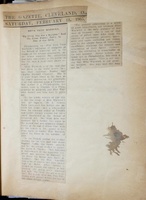 The Gazette_February 11, 1905
 Three clipped newspaper articles from "The Gazette, Cleveland, O., " dated "Saturday, February 11, 1905" Article is as follows: "Meta Vaux Warwick, "My Child, You Are a Sculptor," Said the Great Master, Rodin, to One of Our Girls. Philadelphia, Pa. - Miss Meta Vaux Warwick's[sic] exhibition of sculpture at the School of Industrial Art, in the rooms of the Alumni association, under whose auspices the exhibition was held, was closed to the public on the 4th, said a local daily paper recently.
Miss Warwick is of the race that has given to the world Henry Tanner, Paul Laurence Dunbar and Charles Waddell Chesnutt. She is of pure Negro blood as far back as the fourth generation, her grandfather at that removed being a Caucasian. Her mother is a Philadelphian, her father, born in Virginia, is a Philadelphian by adoption, and Miss Warwick herself was born here 27 years ago.
To the public schools of this city is due the credit of Miss Warwick's first art impulse. Mr. J. Liberty Tadd instructed her before she entered her teens, and a scholarship from the grammar school at Twelfth and Locust streets secured her three years' instruction at the School of Industrial Art. Her work here was extended for a further two years in the normal and post graduate departments, at the end of which time, with all the honors in the power of her alma mater to confer, Miss Warwick sailed for Paris in the autumn of 1899.
In the French capital she studied drawing for the first half year under Raphael Collin, the figure painter, and for the second worked in modeling under M. Charles. Then followed a twelve month at the Academie Colarossi and lectures on anatomy at the Ecole des Beaux Arts under M. Injalbert. One day Miss Warwick took a bit of plaster, not eight inches high, to Rodin. After turning it around in silence, the master at last touched the young girl's shoulder and said: 'My child, you are a sculptor.' For a year after this Miss Warwick's work passed before the eyes of the great French realist.
The present exhibition is a work of great importance, not because Miss Warwick is the only sculptor of her race or because she is one of that group of gifted ones who, from the embers of oppression, poverty, ignorance and caste exclusion are rising, and by the simple force of individual excellence, claiming the respect and admiration of their fairer countrymen; the exhibition is remarkable on its own account. Never before, certainly not in Philadelphia, has such a showing been made. This is not saying that Miss Warwick is our greatest sculptor. She may and she may not be."
-
 Philadelphia Newspaper Article_1905
 Long newspaper article over two pages of the scrapbook. Header is "Philadelphia, Sunday, February 5" and date is broken off, but must be 1905 as the article overall is about her exhibition at the School of Industrial Art. Article includes three photographs, one profile of Meta, one of her dressed in Greek costume, and one of her bust of Sylvia. Full transcription is saved on the server.
-
The Evening Star_January 21, 1905
Newspaper article with the headline "the Evening Star/Saturday, January 21, 1905". The text is as follows: "Miss Warwick's Success in Sculpture. Considerable attention is being given in Philadelphia this week to Miss Meta Vaux Warrick's exhibition of sculpture. Miss Warwick is the sister-in-law of F. L. Cardozo, supervising principal of the thirteenth division, colored, of the Washington public schools. She has made her name stand for the highest things in art, and is regarded as on a plane with Henry Tanner, Paul Lawrence Dunbar and other prominent members of her race. Her work is described as a little below the average in technique, but of unusual strength. In her choice of original themes she is said to be remarkable. Never before has such a showing been made in Philadelphia, according to an art critic of that city."