 Water Boy
 "Meta Vaux Warrick Fuller (American/Philadelphia, 1877-1968), "The Water Boy", 1930, painted plaster, initialed in monogram "MVWF" on base, inscribed "Dorothy Warrick" on white-painted bottom of base, height 12 1/4 in., width 6 in., depth 4 1/2 in. Provenance: Ex-Collection of Dorothy Warrick, Philadelphia, PA; to current owner. Note: This is a rare cast of a well-known work by a prominent African-American woman artist, Meta Vaux Warrick, who married Dr. Simon Fuller (1871-1957) of Liberia in 1909 This exceptional plaster, finished in gold paint, may be more richly worked than the version in unpainted plaster (collection of Simon Fuller) usually illustrated in discussions of her work; it was certainly retained by her niece, Dorothy Warrick, who inscribed the lower block of the base. The artist had been a student at the Pennsylvania Academy of Fine Arts, and then in Paris at the École des Beaux-Arts, and eventually with the most celebrated sculptor of the age, Auguste Rodin in 1902-1903 This figure is indicative of the powerful style of Romantic Realism which Fuller brought to the sculpture of African experiences in America. Reference: Schmidt, Mary, ed. Harlem Renaissance Art of Black America. Campell: New York, 1987, pp. 177-179, color plate 24." Auction report
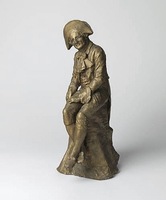 Peeping Tom of Coventry (or Bob Acres?)
 "This is the first important sculpture and the earliest work by Fuller to come to auction. In 1899, the young Ms. Warrick graduated from the Pennsylvania Museum School for Industrial Arts with honors. With a letter of introduction to Henry Ossawa Tanner, she moved to Paris in late October to continue her studies at L'École des Beaux Arts. Fuller befriended Tanner, and received advice and support from the sculptors Augustus Saint-Gaudens and August Rodin. Rodin's sponsorship facilitated an exhibition of 22 sculptures at L'Art Nouveau Gallery in 1902, as well as her inclusion in the Salon of 1903.
Fuller's most famous work, The Awakening of Ethiopia, circa 1910, in the collection of the Schomburg Library and Research Center in Harlem, is considered one of the early symbols of the Harlem Renaissance and among the first American art works to reflect the influence of African sculpture. Benjamin Brawley's 1918 work, The Negro in Literature and Art in the United States, describes her as one of the first artists to explore "the tragedy of the Negro Race in the New World." Brawley mentions Peeping Tom as one of the many early works that did not survive the artist's disastrous studio fire in Philadelphia in 1910. Apparently, it was only missing at the time, or this version was not known to exist. This plaster figure was in the artist's estate when she passed away in 1968.
The Peeping Tom character comes from the legend of Lady Godiva's naked ride through the streets of Coventry. In the tale, the townsfolk agreed not to observe Godiva as she passed by, but Peeping Tom bore a hole in a door to spy on her. According to the legend, he was immediately struck blind. Leininger-Miller pp. 8-9; Campbell p. 177."
Swann Auction Galleries, February 23, 2010
Incised "Meta Vaux Warrick" and dated "99" in the plaster, lower right.
 Harriet Tubman
  Head of a Woman (Disdain)
  Head of a Woman (Vanity)
  Head of of a Woman (Scorn)
  Untitled (Portrait of a Young Boy, Beggar Boy)
  Water Boy (standing)
  Water Boy (bending)
  The Slave Ship
  Peace Halting the Ruthlessness of War_right